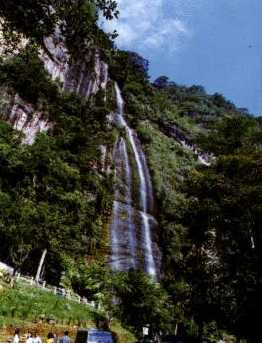
Payakumbuh is known for its gelamai, a kind of sweetmeat, and for its traditional horse races. The area is also boasts a large number of grand traditional houses, one of them said to be more than 200 years old. They can be found especially at Koto nan Ampek, Koto nan Gadang and Taram. Further on the road, near Suliki is the renowned Harau Valley, located at the distance of 14 kilometers from Payakumbuh. This is a green valley enclosed by perpendicular granite walls of many colors, 100 to 200 meters high. Three waterfalls - Sarasah Bunta, Sarasah Murai, and Sarasah Aka Barayun - disgorge their water down the cliffs onto the valley. The Harau Valley is part of a nature and wildlife reserve, in which many forms of plant and animal life can be found, including tigers, wild boat, forest goats, deer and tapir. There is space for camping, and the cliffs are excellent for climbing.
Suliki and Koto Tinggi derive their renown from the role which they played during Indonesia’s war independence in 1948, when Dutch troops occupied the Republican war capital Yogyakarta on the island of Java, and Kota Tinggi was made the seat of the Emergency Government of the Republic of Indonesia. Near Payakumbuh, at Padang Mangatas, is a horse breeding farm. Evidence of the existence of a civilized human community in the Limapuluh-Koto area in prehistoric times is found in the presence there of about 2,000 menhirs - upright stone monuments - scattered across a wide area in the subdistricts Guguk, Suliki, and Gunung Emas. A small museum, attached to the site, is found at Guguk. Ngalau Indah is a small cave with a lookout post in the limestone hills outside Payakumbuh. The site offers an impressive view of the paddies and coconut groves in the lush surrounding countryside. At a distance of 4 kilometers from the center of town is Batang Tabik, a swimming pool filled with clear, cool water. A restaurant there specialized in fresh broiled fish dishes.
Andaleh is village about five kilometers from Payakumbuh, which is known for its rattan bags, hats, lamp shades, food covers and other articles. Not far from the main road, in the direction of Lintau, on the slope of the Sago Mountain 21 kilometers from Payakumbuh, is the Halaban, a formerly Dutch-owned tea plantation. Besides tea, area is also known for its pineapples. As one travels in the direction of Pekanbaru, in Riau province, the road winds up the mountains, passes a stretch with nine hairpin turn known as Kelok Sembilan, then Pintu Angin and Ulu Air, and finally reaches a point called Panorama Selat Malaka (Malacca Strait Panorama). The view from this vantage point is breath-taking. Towards the west and south, the hills and mountains of the Bukit Barisan range loom against the sky, their distant peaks blurred in the haze. Towards the east, the lowland plains of Riau are clearly visible. On clear days, the vista stretches as far as the blue waters and the dots of islands in the Malacca Strait beyond.
Klik disini untuk melanjutkan »»